Pre-funding fellowship · 8-12 weeks · 8-10 hrs/week

Graduate AI-Native
Product Feature Owner Fellowship

Help shape a real privacy-first Family Intelligence AI platform. Work with AI every day to define features, improve UX, validate quality and localise the product for each country.

A structured pre-funding fellowship for graduates who want hands-on product ownership experience in AI, privacy, family technology and automated delivery.

Why join allme.life

Most graduates do not get the chance to work on a serious product while it is still being shaped. At allme.life, you will not be joining a blank idea. You will help refine a working AI-native platform that brings together family documents, tasks, notes, calendars, communication, health, finance, learning and family administration.

You will learn how product features move from user problem → feature definition → user story → acceptance criteria → test scenario → automated build → review → release → continuous improvement. You will also help explore country-specific implementation: how features should adapt for local documents, regulations, language, family norms and market expectations.

Important transparency

This is a structured pre-funding fellowship, not a paid employment role at this stage. Designed to fit alongside job search or study. No guaranteed job at the end — though strong, committed participants may be considered first for future paid roles if funding or revenue allows.

Own a domain end-to-end

You won't just be writing user stories. You take ownership of a domain — and answer the harder questions about where it is, where it's going, and how it fits into the platform's bigger picture.

Each fellow chooses one of allme.life's product domains — Wealth, Health, Learn & Grow, My Tribe (family administration), Platform UX, AI Intelligence, or Localisation — and treats it as their portfolio piece for the cohort.

For your domain, you will:

  • Build a strategy — what does winning look like for families in this domain? What does the next 1, 2 and 5 years look like? What are the moments where allme.life earns trust, and where it falls short today?
  • Research the existing build — read what's already shipped, understand the current architecture, user flows, data model and acceptance criteria. Identify the gaps between today's product and tomorrow's vision.
  • Align existing development with the future vision — write the bridge story. From where the domain is today to where it needs to be: what should be refined, redesigned, deprecated, accelerated, or built from scratch?
  • Keep it true to the over-arching platform vision — every decision must serve families and individuals in their personal lives. allme.life is the operating system for what happens at home, between generations, across a lifetime — not a corporate or workplace tool. The strategy you write must reinforce that boundary at every level.

This is what separates the fellowship from a typical internship: you leave with a portfolio piece that says "I owned the strategy and execution for one domain of a real AI-native platform", not "I helped a team with tasks for three months."

The seven domains

Each domain is a meaningful piece of family life that allme.life is building toward. Choose the one where you have curiosity, lived experience, or strong opinions about what families actually need.

Domain 01

Wealth

Your family's financial life, intelligently organised — without anyone reading the numbers.

Bank accounts, bills, savings goals, insurance, tax documents, inheritance planning. allme.life pulls these into one private home where the family sees the full picture; we (and the bank) see nothing. Underpinned by the WEALTH subsystem.

TodayFoundational data model; Open Banking integration on the roadmap.
You'd shape: How does a family's financial picture become legible across generations — parents managing a household, grandparents planning legacy, children learning money? What does proactive AI wealth coaching look like inside a zero-knowledge contract?
Domain 02

Health

One private home for the family's health, across every generation.

Medical records, prescriptions, vaccinations, allergies, appointments, wellness tracking, ageing-parent care plans, child immunisation logs — currently fragmented across NHS apps, paper letters, GP portals and memory. The WELLBEING subsystem brings it together.

TodaySubsystem data model + privacy boundaries shipped; per-member health profiles and reminder loops in development.
You'd shape: How does the family health system serve a grandparent on Windows differently from a teenager on Android? Where does the AI nudge cross from caring to nagging? How do NHS / EU health records connect cleanly when those gateways open?
Domain 03

Learn & Grow

A lifetime of learning, in your family, on your terms.

Personal development, cultural and spiritual learning, education records (school, university, professional), skill building, family knowledge transfer between generations, AI-tailored coaching. The subsystem name CHARDI KALA (Punjabi: "high spirits / rising spirit") reflects the intent: families thriving, not just functioning.

TodayPRISM principle library (~9,850 principles across 12 domains) underpins reasoning; coaching patterns being designed (DN-INV-05).
You'd shape: How does the platform support a child's coursework, a parent's career pivot, and a grandparent's lifelong creative practice — all in the same private space, without one user's growth becoming someone else's surveillance signal?
Domain 04

My Tribe

Who's in your family, and how you work together.

The family graph: who's a member, what their role is (parent, child, grandparent, extended family, trusted friend), what they can see, what they can edit, what they're responsible for. The foundation that lets shared calendars, documents and decisions work safely across the household. Lives in the MY_TRIBE subsystem.

TodayExternalContact / ContentShare / ShareLink / ShareAuditLog models live; "Five Rooms" UX redesign documented (DN-TRIBE-001); Jerry x Sage x ORACLE integration scoped (DN-TRIBE-AGENTS).
You'd shape: How does the family graph evolve as life events happen — births, marriages, divorces, deaths, role transitions? What's the right balance of privacy within a family (teenager's diary stays private; parent's medical records shared with adult child but not the teen)?
Domain 05

Platform UX

The whole platform, designed for every generation in your family.

Cross-cutting: experience patterns, navigation, accessibility, onboarding, multi-device journeys and the design system that makes allme.life feel coherent across email, drive, calendar, notes, tasks and Jerry. The dimension that makes the grandmother on Windows and the teenager on Android feel like they're in the same home.

TodayFlutter app in active development; onboarding + first-value flows documented (DN-SYS-ONBOARD); accessibility AC enforced on every story.
You'd shape: What does a family operating system look like at a UX level that nobody has built before? How do you design for ages 6 to 80+, for varying tech literacy, for different cognitive loads (new parent vs retired grandparent), across one shared product?
Domain 06

AI Intelligence

The brain of the platform — Jerry and the agents around it.

Jerry (user-facing family AI) plus the upstream reasoning layer: PRISM (principles), KEEL (ethical output discipline), ATHENA (research ingestion), SAGE (daily analysis), ORACLE (longer-horizon), NEXUS (rules engine). The constraint that makes this domain unique: every model operates within zero-knowledge boundaries — never holding raw plaintext data beyond a transient processing window.

TodayJerry routing + tool-use shipped (DN-JERRY-ROUTER); PRISM has ~9,850 curated principles loaded across 12 domains on DEV; KEEL output discipline + citation collector shipped; ATHENA ingestion pipeline live.
You'd shape: How does family AI feel different from corporate AI? What does proactive intelligence (Jerry suggests something before you ask) look like inside a privacy budget? How do you make the AI feel like a family member, not a surveillance system?
Domain 07

Localisation

The same family problem exists everywhere; the details don't.

The framework that lets allme.life adapt for the UK (first market), the EU (2027), and further. Different countries have different school-form vocabulary, medical-record structures, tax-document types, family norms, consent rules, and digital-identity systems (EUDIW for the EU). Captured by the AEGIS (Digital Readiness) subsystem.

TodayAEGIS subsystem registered (DN-011, DN-INV-07); EUDIW-conformant credential foundation planned (DN-IMPL-FLW-AEGIS); UK-first cohort.
You'd shape: What does country-specific implementation actually look like at scale? How do you avoid building 27 forks of the platform? How do you keep the universal principles (zero-knowledge, family-first) intact while changing forms, language, tax templates, school admin patterns and consent rules?
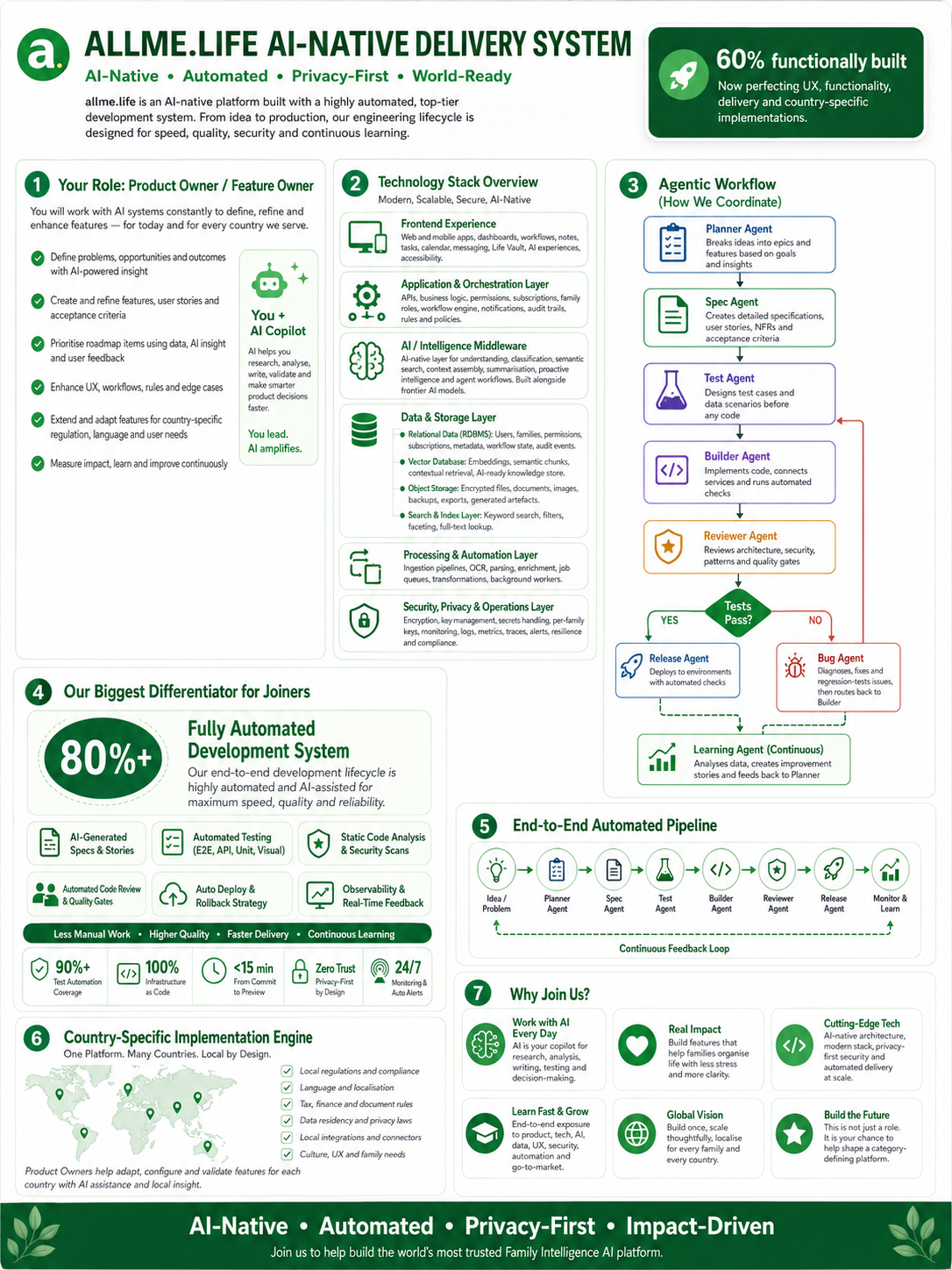
What you'll do

As a Product Feature Owner, you lead the product thinking. AI accelerates the research, structure and validation.

  • Discover user needs and translate them into clear problem statements.
  • Define product features with AI assistance.
  • Write user stories, rules, workflows and acceptance criteria.
  • Review UX journeys and suggest improvements.
  • Prepare test scenarios and edge cases before build.
  • Support country-specific implementation.
  • Analyse feedback and create improvement stories.
  • Build portfolio-ready product documents.

An AI-native product and delivery system

allme.life is built with a modern technology architecture: frontend family experiences, application and workflow logic, AI intelligence middleware, relational data, vector knowledge, object storage, search and indexing, automated processing pipelines, privacy controls, observability and secure operations.

Our development workflow is designed to be highly automated and AI-assisted. Planner, Specification, Testing, Builder, Reviewer, Release and Learning workflows help move features from idea to validated release with speed, discipline and quality.

For fellows, this means learning product ownership in the same way modern AI-era software is being built. Approximately 80% or more of the build, test and validation workflow is automated or AI-assisted, with human approval gates for planning, code, deployment and rollback decisions.

AI-native Product Feature Owner workflow and automated development system

Figure: AI-native Product Feature Owner workflow and automated development system

Fellowship details

Places5-6 fellows in the first cohort
Duration8-12 weeks initial programme
CommitmentApproximately 8-10 hours per week, flexible
FormatWeekly group session, founder/product review, independent AI-assisted product work, and ownership of one domain — building strategy, researching existing development, aligning the domain's future vision with the over-arching platform vision
DomainsWealth · Health · Learn & Grow · My Tribe (family administration) · Platform UX · AI Intelligence · Localisation
OutcomePortfolio-ready product work and a reference/recommendation for committed participants
Paid statusUnpaid pre-funding fellowship. Not a paid employment role and no guaranteed job outcome.

Who should apply

  • Graduates interested in Product Ownership, Product Management, Business Analysis, UX Research, AI product design, SaaS, digital health, fintech, edtech, family technology or privacy technology.
  • Candidates who are curious, organised, reliable and clear communicators.
  • People comfortable using AI tools and learning modern product delivery methods.
  • People who want practical experience and portfolio outputs rather than only theory.

Frequently asked questions

Is this a paid role?

No. This is a transparent pre-funding fellowship and not a paid employment role at this stage.

Is there a guaranteed job afterwards?

No. If funding or revenue allows, committed and high-performing fellows may be considered first for future paid roles, but this is not guaranteed.

How much time is expected?

Approximately 8-10 hours per week, designed to be compatible with job search, study or other responsibilities.

Do I need coding skills?

No. Coding is not required for Product Feature Owner work, although technical curiosity is helpful.

Will I work with real user data?

No sensitive live user data should be used during the fellowship unless formal controls are in place. Work should use test, sample or anonymised scenarios.

What will I gain?

Product ownership experience, AI-assisted delivery exposure, portfolio-ready outputs, founder feedback and a reference/recommendation for committed participation.

Apply to the fellowship

A short application — about 5 minutes. We review every submission and respond personally.

Thank you

Your application has been received. We review every submission and will respond within a few working days. If shortlisted, you'll be invited to an information session and asked to complete a short product-thinking exercise.

— allme.life